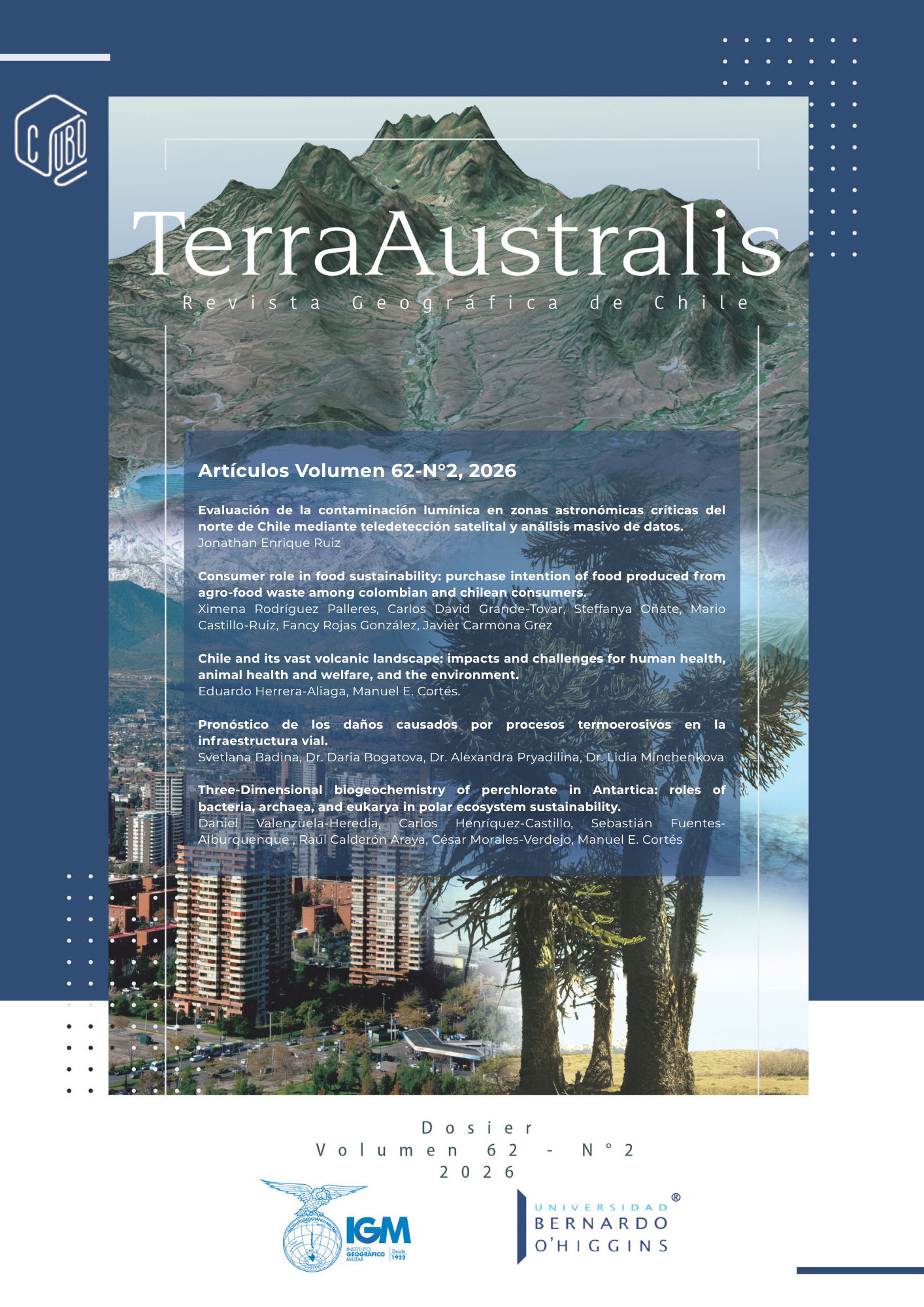
Light Pollution Assessment in Critical Astronomical Areas of Northern Chile Using Satellite Remote Sensing and Big Data Analysis
DOI:
https://doi.org/10.23854/07199562.2026622.ruizKeywords:
light pollution, astronomical observatories, satellite remote sensing, VIIRS-DNB, dark sky conservationAbstract
This study quantitatively assessed the evolution of light pollution in the surroundings of the Cerro Paranal and ALMA astronomical observatories, located in northern Chile, from 2014 to 2024. To achieve this, satellite data from the VIIRS-DNB sensor were used, processed through Google Earth Engine, generating time series of artificial radiance corrected for natural background levels. Concentric buffers of 10, 25, 50, 100, and 150 km were defined around both observatories, and annual average radiance values were calculated by applying zonal statistics methods and standardized quality filters. The results revealed a sustained increase in artificial radiance in both areas, particularly in the nearest buffers: at Cerro Paranal, the increase reached up to 470 % within the 10 km zone, while at ALMA it reached 12 000 %, mainly attributed to the expansion of urban, mining, and energy infrastructure. Significant changes were identified starting in 2020, coinciding with the development of megaprojects and improvements in sensor sensitivity. The methodology proved to be effective, reproducible, and scalable for monitoring spatial trends in remote areas. However, the findings also highlight the urgent need to update light pollution regulations, expand astronomical protection perimeters, and establish stricter criteria in the environmental assessment of new projects, integrating remote sensing tools into land-use and environmental planning to preserve dark skies as a scientific, cultural, and ecological heritage.
Downloads
References
Patat, F. (2003). Systematic optical atmospheric extinction at Paranal: First results from the FORS1 Exposure Time Calculator. The Messenger, 114, 20-23.
Bará, S. (2016). Anthropogenic disruption of the night sky darkness in urban and rural areas. Royal Society Open Science, 3(10), 160541. https://doi.org/10.1098/rsos.160541
Bely, P. Y. (2002). The design and construction of large optical telescopes. Springer Science & Business Media.
Cao, C., & Bai, Y. (2014). Quantitative analysis of VIIRS DNB nightlight point source for light power estimation and stability monitoring. Remote Sensing, 6(12), 11915-11935. https://doi.org/10.3390/rs61211915
Chepesiuk, R. (2009). Missing the dark: health effects of light pollution. Environmental Health Perspectives, 117(1), A20–A27.
Cinzano, P., Falchi, F., & Elvidge, C. D. (2001). The first world atlas of the artificial night sky brightness. Monthly Notices of the Royal Astronomical Society, 328(3), 689-707. https://doi.org/10.1046/j.1365-8711.2001.04882.x
Duriscoe, D. M., Luginbuhl, C. B., & Moore, C. A. (2007). Measuring night-sky brightness with a wide-field CCD camera. Publications of the Astronomical Society of the Pacific, 119(852), 192–213.
Elvidge, C. D., Baugh, K. E., Zhizhin, M., & Hsu, F. C. (2017). VIIRS night-time lights: A global view of Earth at night. International Journal of Remote Sensing, 38(21), 5860-5879. https://doi.org/10.1080/01431161.2017.1342050
Elvidge, C. D., Baugh, K. E., Zhizhin, M., Hsu, F.-C., & Ghosh, T. (2016). Methods for global survey of natural gas flaring from visible infrared imaging radiometer suite data. Energies, 9(1), 14. https://doi.org/10.3390/en9010014
Falchi, F., Cinzano, P., Duriscoe, D., Kyba, C. C., Elvidge, C. D., Baugh, K., ... & Furgoni, R. (2016). The new world atlas of artificial night sky brightness. Science Advances, 2(6), e1600377. https://doi.org/10.1126/sciadv.1600377
Garstang, R. H. (1989). Night-sky brightness at observatories and sites. Publications of the Astronomical Society of the Pacific, 101(637), 306-329. https://doi.org/10.1086/132436
Gaston, K. J., Bennie, J., Davies, T. W., & Hopkins, J. (2013). The ecological impacts of nighttime light pollution: a mechanistic appraisal. Biological Reviews, 88(4), 912-927.
Gorelick, N., Hancher, M., Dixon, M., Ilyushchenko, S., Thau, D., & Moore, R. (2017). Google Earth Engine: Planetary-scale geospatial analysis for everyone. Remote Sensing of Environment, 202, 18-27. https://doi.org/10.1016/j.rse.2017.06.031
IAU Commission B7. (2020). Guidelines for the protection of astronomical sites from light pollution. International Astronomical Union Division A.
Kyba, C. C. M., & Lolkema, D. E. (2012, September 20). A standard format for measurements of skyglow: Definition of the standard data format for skyglow observations (SDF v1.0) [Versión 1.0]. Unihedron.
Kyba, C. C. M., Altintas, O., Walker, C. E., & Newhouse, M. (2023). Citizen scientists report global rapid reductions in the visibility of stars from 2011 to 2022. Science, 379(6629), 265-268. https://doi.org/10.1126/science.abq7781
Kyba, C. C. M., Kuester, T., Sánchez de Miguel, A., Baugh, K., Jechow, A., Hölker, F., ... & Guanter, L. (2017). Artificially lit surface of Earth at night increasing in radiance and extent. Science Advances, 3(11), e1701528. https://doi.org/10.1126/sciadv.1701528
Marín, C., & Jafar, J. (Eds.). (2008). Starlight: A common heritage. Instituto de Astrofísica de Canarias - UNESCO.
Ministerio del Medio Ambiente. (2012). Decreto Supremo N° 43: Norma de emisión para la regulación de la contaminación lumínica. Diario Oficial de la República de Chile (publicado en 2013).
Moyano, R., & Uribe, C. (2012). El volcán Chiliques y el "morar-en-el-mundo" de una comunidad atacameña del norte de Chile. Estudios Atacameños, (43). https://doi.org/10.4067/S0718-10432012000100010
Oficina para la Protección de la Calidad del Cielo del Norte de Chile (OPCC). (2019). Manual de buenas prácticas para la prevención de la contaminación lumínica en zonas astronómicas. CONICYT - Ministerio de Ciencia, Tecnología, Conocimiento e Innovación.
República de Chile. (1998). Decreto Supremo N° 686: Norma de emisión para la regulación de la contaminación lumínica. Ministerio de Economía, Fomento y Reconstrucción.
Román, M. O., Wang, Z., Sun, Q., Kalb, V., Miller, S. D., Molthan, A., ... & Shrestha, R. (2018). NASA's Black Marble nighttime lights product suite. Remote Sensing of Environment, 210, 113-143. https://doi.org/10.1016/j.rse.2018.03.017
Sanhueza, P. (2021, 4 de octubre). Light Pollution: The Chilean Norm [Presentación]. Taller de las Naciones Unidas/Chile sobre las Aplicaciones de los GNSS.
Patat, F., Moehler, S., O'Brien, K., Pompei, E., Bensby, T., Carraro, G., de Ugarte Postigo, A., Fox, A., Gavignaud, I., James, G., Korhonen, H., Ledoux, C., Randall, S., Sana, H., Smoker, J., Stefl, S., & Szeifert, T. (2011). Optical atmospheric extinction over Cerro Paranal. Astronomy & Astrophysics, 527, A91. https://doi.org/10.1051/0004-6361/201015537
Rowse, E. G., Lewanzik, D., Stone, E. L., Harris, S., & Jones, G. (2016). Dark Matters: The Effects of Artificial Lighting on Bats. In C. C. Voigt & T. Kingston (Eds.), Bats in the Anthropocene: Conservation of Bats in a Changing World (pp. 187-213). Springer, Cham.
UNESCO-MAB. (2007). Declaración de La Palma en Defensa del Cielo Nocturno y el Derecho a Observar las Estrellas. Programa el Hombre y la Biosfera (MAB) - Iniciativa Starlight. La Palma, Islas Canarias.
Walker, M. F. (1977). The effects of urban lighting on the brightness of the night sky. Publications of the Astronomical Society of the Pacific, 89(529). https://doi.org/10.1086/130142
Walker, M. F. (1987). Site testing and the development of large optical telescopes. In R. L. Millis, O. G. Franz, H. D. Ables, & C. C. Dahn (Eds.), Identification, Optimization and Protection of Optical Telescope Sites (pp. 128-140). Lowell Observatory.
Downloads
Published
How to Cite
Issue
Section
License
Copyright (c) 2026 Revista Geográfica de Chile Terra Australis

This work is licensed under a Creative Commons Attribution 4.0 International License.
Copyright notice:
Revista Geográfica de Chile Terra Australis retains the economic rights (copyright) of the works published in the Revista Geográfica de Chile Terra Australis. The reuse of the content is allowed under a license:
CC BY
Recognition

This license allows others to distribute, remix, tweak and build upon your work, even for commercial purposes, as long as you are acknowledged as the author of the original creation. This is the most helpful license offered. It is recommended for maximum dissemination and use of the materials subject to the license.