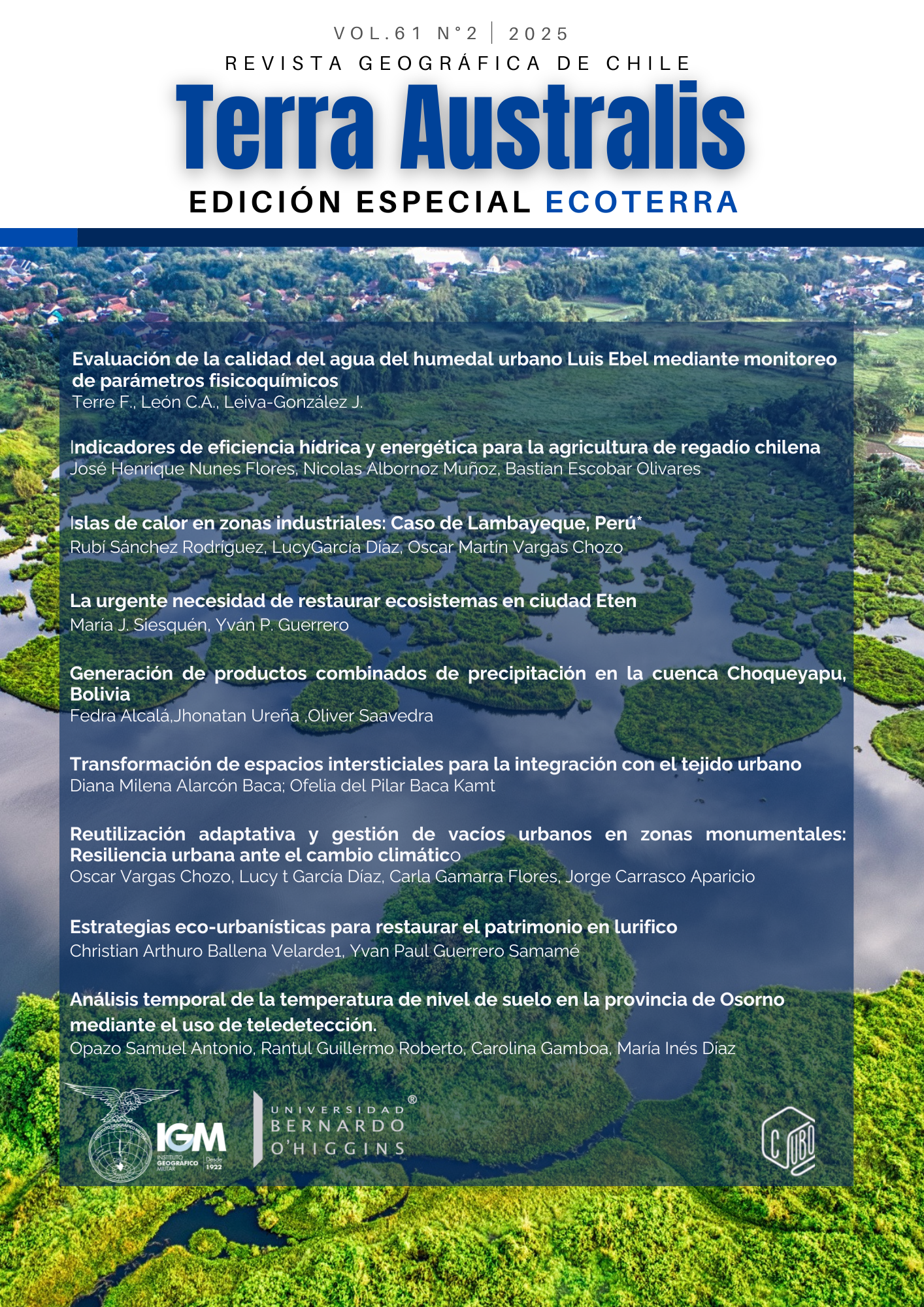
EVALUATION OF WATER QUALITY IN THE LUIS EBEL URBAN WETLAND THROUGH PHYSICOCHEMICAL PARAMETER MONITORING
DOI:
https://doi.org/10.23854/07199562.2025612.terreKeywords:
humedal urbano, calidad de agua, parámetros fisicoquímicos, índice calidad de agua (ICA), eutrofizaciónAbstract
The study was conducted in the Luis Ebel urban wetland, located in Puerto Montt, Chile, and assessed water quality by monitoring key physicochemical parameters, following environmental regulations. This ecosystem, of significant ecological importance, faces pressures from human activities, highlighting the need for conservation and sustainable management strategies. In situ measurements were carried out for parameters such as dissolved oxygen, pH, and electrical conductivity, complemented by laboratory analyses to determine phosphorus, nitrates, nitrites, and Chemical Oxygen Demand (COD). The research proposed a Water Quality Index (WQI), which classifies parameters into two groups: general parameters (pH, electrical conductivity, dissolved oxygen, and COD), which provide basic information about water quality and are regularly monitored by Chile's General Water Directorate (DGA), and complementary parameters (nitrates, nitrites, and phosphorus) associated with the eutrophication process. The results indicated that water quality ranges between "regular" and "good" according to the proposed WQI. Elevated phosphorus concentrations in some areas, likely from anthropogenic sources, were noted, while indicators such as dissolved oxygen and electrical conductivity reflected favorable conditions. This study highlights the usefulness of the WQI as a tool to synthesize water quality information and facilitate continuous monitoring. Additionally, it emphasizes the importance of implementing adaptive management strategies to reduce pollution sources and protect the wetland’s biodiversity.
Downloads
References
Aguilar Alba, M., Vetter, M., Mena Berrios, J.B., & Pérez Martínez, T. T. (2010). Modelización del comportamiento de variables limnológicas en relación con el cambio climático en el lago Ammersee (Alemania). Tecnologías de la información geográfica: la información geográfica al servicio de los ciudadanos, 1157-1167.
Bassi, N., & Kumar, M. D. (2017). Water quality index as a tool for wetland restoration. Water Policy, 19(3), 390–403. https://doi.org/10.2166/wp.2017.099
Canadian Council of Ministers of the Environment. (2004). Canadian water quality guidelines for the protection of aquatic life: Phosphorus: Canadian Guidance Framework for the Management of Freshwater Systems. In: Canadian environmental quality guidelines, 2004, Canadian Council of Ministers of the Environment, Winnipeg.
Carpenter, S. R., Caraco, N. F., Correll, D. L., Howarth, R. W., Sharpley, A. N., &
Smith, V. H. (1998). Nonpoint pollution of surface waters with phosphorus and nitrogen. Ecological applications, 8(3), 559-568.
Coccia, C., Vega, C., & Fierro, P. (2022). Macroinvertebrate-Based Biomonitoring of Coastal Wetlands in Mediterranean Chile: Testing Potential Metrics Able to Detect Anthropogenic Impacts. Water (Switzerland), 14(21). https://doi.org/10.3390/w14213449
Convención de Ramsar sobre los Humedales. (2018). Perspectiva mundial sobre los humedales. https://www.ramsar.org/sites/default/files/documents/library/gwo_s.pdf
Costanza, R., de Groot, R., Sutton, P., van der Ploeg, S., Anderson, S. J., Kubiszewski, I., Farber, S., & Turner, R. K. (2014). Changes in the global value of ecosystem services. Global Environmental Change, 26(1), 152–158. https://doi.org/10.1016/j.gloenvcha.2014.04.002
Dar, S. A., & Bhat, S. U. (2022). Wetland ecosystem monitoring through water quality perspectives. Handbook of Research on Monitoring and Evaluating the Ecological Health of Wetlands , 51–70.
Davis, C. A., & Anderson, J. T. (Eds.). (2013). Wetland Techniques (Vol. 1). Springer. https://doi.org/10.1007/978-94-007-6860-4
Decreto 122 (2010). Establece normas secundarias de calidad ambiental para la protección de las aguas del lago Llanquihue. Biblioteca del Congreso Nacional de Chile. Santiago, 17 de noviembre de 2009.
Girardi C., Rachel Charte, Mariela Elorrieta, Fernando González, Sebastián Jara, Andrea Arancibia, & Iván Castillo. (2018). Metodología de Construcción de Índice de calidad para aguas superficiales (Issue Escenarios Hídricos 2030).
Hua, K., & Zhu, B. (2020). Phosphorus loss through surface runoff and leaching in response to the long-term application of different organic amendments on sloping croplands. Journal of Soils and Sediments, 20, 3459-3471. https://doi.org/10.1007/s11368-020-02675-3
Herbert, E. R., Boon, P., Burgin, A. J., Neubauer, S. C., Franklin, R. B., Ardon, M., Hopfensperger, K. N., Lamers, L. P. M., Gell, P., & Langley, J. A. (2015). A global perspective on wetland salinization: Ecological consequences of a growing threat to freshwater wetlands. In Ecosphere (Vol. 6, Issue 10). Ecological Society of America. https://doi.org/10.1890/ES14-00534.1
Kingsford, R. T., Basset, A., & Jackson, L. (2016). Wetlands: conservation’s poor cousins. In Aquatic Conservation: Marine and Freshwater Ecosystems (Vol. 26, Issue 5, pp. 892–916). John Wiley and Sons Ltd. https://doi.org/10.1002/aqc.2709
Knox, A. K., Dahlgren, R. A., Tate, K. W., & Atwill, E. R. (2008). Efficacy of Natural Wetlands to Retain Nutrient, Sediment and Microbial Pollutants. Journal of Environmental Quality, 37(5), 1837–1846. https://doi.org/10.2134/jeq2007.0067
Ley Nº 21.202, modifica diversos cuerpos legales con el objetivo de proteger los humedales urbanos. Diario Oficial de la República de Chile, 23 de enero de 2020. https://bcn.cl/2fff9
MMA, (2024), Ministerio del Medio Geoportal SIMBIO. Revisado 3 agosto desde https://apps.mma.gob.cl/visorsimbio
Mitsch, W. J., & Gosselink, J. G. (2015). Wetlands. Water Resources, 736. https://www.wiley.com/en-be/Wetlands%2C+5th+Edition-p-9781119019787
MMA-ONU Medio Ambiente. (2022). Guía de monitoreo de humedales. Elaborada por María Jesús Suazo Suazo, consultora proyecto GEF/SEC ID_9766 "Conservación de humedales costeroes de la zona centro sur de Chile" Ministerio del Medio Ambiente, Santiago, Chile. 48p.
Prigent, C., Papa, F., Aires, F., Jimenez, C., Rossow, W. B., & Matthews, E. (2012). Changes in land surface water dynamics since the 1990s and relation to population pressure. Geophysical Research Letters, 39(8).
Poojashree, B. P., Peladdy, B., Kaveri, H., Akkivalli, P., & Swathi, L. A. (2022). Determination of Physio-Chemical Parameters and Water Quality Index (Wqi) of Kundapura Taluk, Udupi District, Karnataka, India. Pollutants, 2(3), 388-406.https://doi.org/10.1029/2012GL051276
Rodríguez-Jorquera, I., Rivera-Bravo, D., Sciaraffia, F., Márquez García, M., Tomasevic, J.A., Mellado, C., & Möller, P. 2020. “Propuesto de criterios mínimos para la sustentabilidad de humedales urbanos en Chile”. Informe Final. Centro de Humedales Río Cruces de la Universidad Austral de Chile, Centro de Derecho y Gestión de Aguas de la Pontificia Universidad Católica de Chile, GeoAdaptive LLC y Ministerio del Medio Ambiente, Santiago, Chile.
Schindler, D. W. (2012). The dilemma of controlling cultural eutrophication of lakes. Proceedings of the Royal Society B: Biological Sciences, 279(1746), 4322-4333.
Teusch C., Scheuch T., Fernández ., Briceño F., Vattuone C., Domínguez J. C., Riveros A., Pichunleo E., Moreno O., & Gironás J.. (2024). Exploring the Behavior of Llanquihue’s Urban Wetlands: Lessons Learnt and Perspectives for Water-Sensitive Urban Design. Urban Wetlands in Latin America: Protection, Conservation, Innovation, Restoration, and Community for Sustainable and Water Sensitive Cities., 73–88.
Villagrán-Mella, R. Aguayo, M. Parra, L. E. & González, A. (2006). Relación entre características del hábitat y estructura del ensamble de insectos en humedales palustres urbanos del centro-sur de Chile. Revista Chilena de Historia Natural, 195–211.
Wang, X., Shang, S., Qu, Z., Liu, T., Melesse, A. M., & Yang, W. (2010). Simulated wetland conservation-restoration effects on water quantity and quality at watershed scale. Journal of Environmental Management, 91(7), 1511–1525. https://doi.org/10.1016/j.jenvman.2010.02.023
Downloads
Published
How to Cite
Issue
Section
License
Copyright (c) 2025 Revista Geográfica de Chile Terra Australis

This work is licensed under a Creative Commons Attribution 4.0 International License.
Copyright notice:
Revista Geográfica de Chile Terra Australis retains the economic rights (copyright) of the works published in the Revista Geográfica de Chile Terra Australis. The reuse of the content is allowed under a license:
CC BY
Recognition

This license allows others to distribute, remix, tweak and build upon your work, even for commercial purposes, as long as you are acknowledged as the author of the original creation. This is the most helpful license offered. It is recommended for maximum dissemination and use of the materials subject to the license.