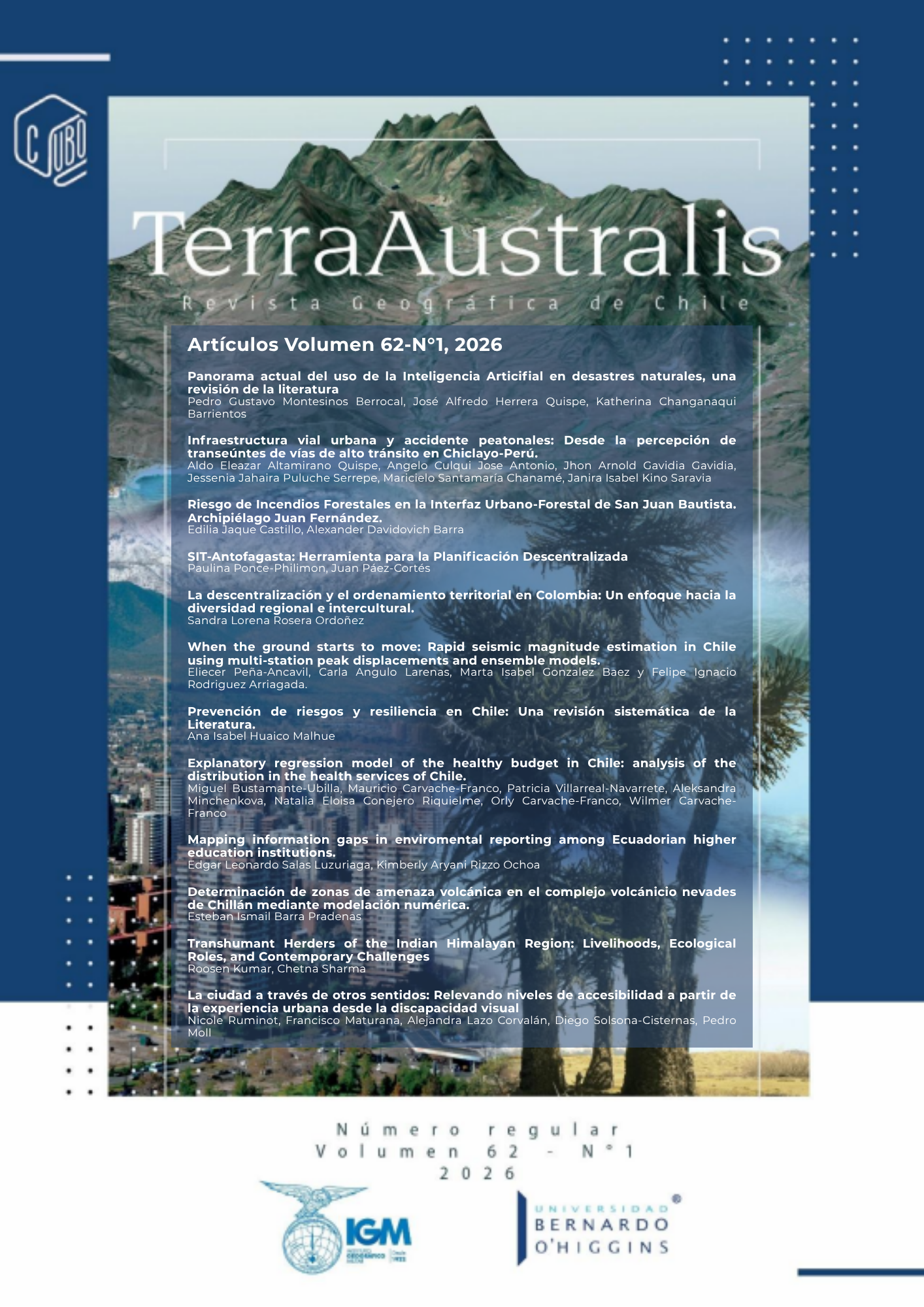
MAPPING INFORMATION GAPS IN ENVIRONMENTAL REPORTING AMONG ECUADORIAN HIGHER EDUCATION INSTITUTIONS
DOI:
https://doi.org/10.23854/07199562.2026621.salasKeywords:
academic accountability, circular economy, transparency paradoxAbstract
This research evaluates the critical information gap in environmental disclosure among Ecuadorian Higher Education Institutions (HEIs) through the lens of the circular economy. Utilizing a systematic methodology grounded in the PRISMA framework, the study initially screened 272 institutional records to focus on a rigorous sample of 63 universities and polytechnic schools with comparable administrative mandates. The results uncover a stark “Transparency Paradox”, despite their vast resources and academic influence, the primary urban hubs of Pichincha and Guayas exhibit reporting rates below 30%, suggesting that institutional density does not correlate with data accountability. Conversely, the Amazonía region, characterized by its ecosystemic fragility and smaller institutional scale, achieves a full 100% transparency rate, aligning institutional identity with environmental preservation. The investigation identifies composting as the dominant valorization strategy due to its low capital requirements, while technologies like biodigestion remain confined to isolated pilot projects in a select group of leader institutions. The analysis demonstrates that institutional funding models and campus size create significant "reporting shadows," where larger campuses generate vast waste volumes without equivalent public accountability. Consequently, the study advocates for the creation of territorial waste management networks and a national observatory to harmonize reporting metrics. By transforming universities from passive waste generators into active nodes of territorial governance, Ecuador can bridge the current data void and align its academic sector with the global 2030 Agenda, ensuring that sustainability moves beyond pilot-scale rhetoric toward a systemic, measurable reality.
Downloads
Downloads
Published
How to Cite
Issue
Section
License
Copyright (c) 2026 Revista Geográfica de Chile Terra Australis

This work is licensed under a Creative Commons Attribution 4.0 International License.
Copyright notice:
Revista Geográfica de Chile Terra Australis retains the economic rights (copyright) of the works published in the Revista Geográfica de Chile Terra Australis. The reuse of the content is allowed under a license:
CC BY
Recognition

This license allows others to distribute, remix, tweak and build upon your work, even for commercial purposes, as long as you are acknowledged as the author of the original creation. This is the most helpful license offered. It is recommended for maximum dissemination and use of the materials subject to the license.