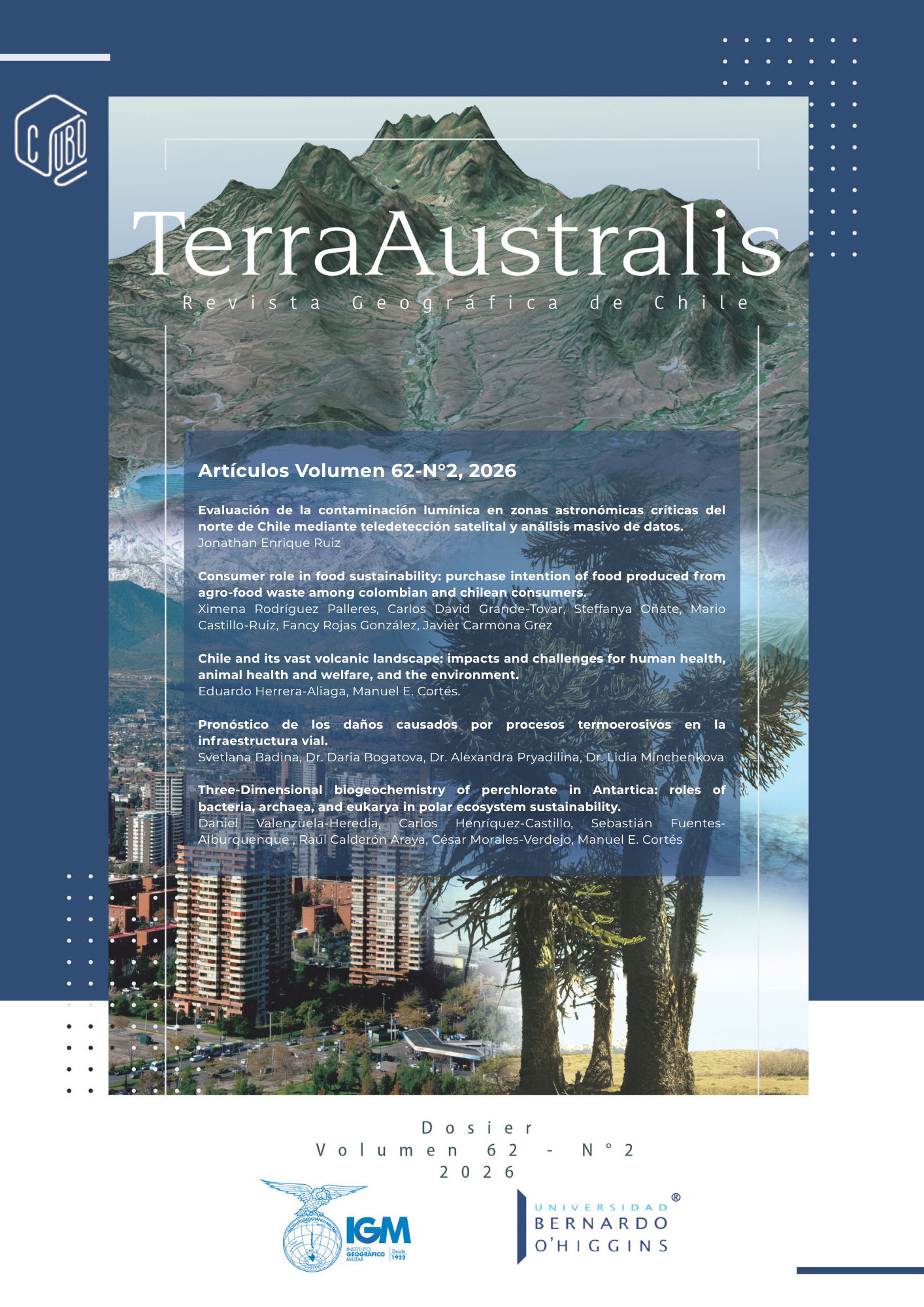
ASSESSMENT OF ECONOMIC LOSSES FROM THERMAL EROSION PROCESSES (THE CASE OF ROAD INFRASTRUCTURE)
DOI:
https://doi.org/10.23854/07199562.2026622.badinaKeywords:
natural hazards, economic damage, Arctic, climate change, permafrost, dangerous permafrost processes, thermo‑erosion, Russia, road infrastructure.Abstract
The objective of this article is to develop a methodology for assessing the replacement cost of roads in order to forecast damages resulting from natural hazards, applying it as an example to the process of thermoerosion. The Yamalo-Nenets Autonomous District was selected as a case study. This is one of the regions of the Russian Arctic located in the permafrost zone, the territory of which is significantly exposed to thermoerosion processes. The problem of intensifying thermoerosive processes has worsened significantly in recent years due to climate change. The research employed statistical methods, a normative approach, and geoinformation analysis techniques. The study found that the maximum potential damage to paved roads in the Yamalo-Nenets Autonomous District in areas of high thermoerosion risk amounts to approximately 1.964 billion U.S. dollars, and that 39% of all roads in the region are in high-risk areas. This value corresponds to the theoretical estimate obtained based on the assumption of an extreme scenario of complete loss (100%) of the vulnerable infrastructure. This line of research is highly relevant in the context of climate change and its consequences, as well as the need to develop adequate adaptation plans. The results can be used in the preparation of climate change adaptation plans and strategic territorial planning documents at various territorial levels.
Downloads
Downloads
Published
How to Cite
Issue
Section
License
Copyright (c) 2026 Revista Geográfica de Chile Terra Australis

This work is licensed under a Creative Commons Attribution 4.0 International License.
Copyright notice:
Revista Geográfica de Chile Terra Australis retains the economic rights (copyright) of the works published in the Revista Geográfica de Chile Terra Australis. The reuse of the content is allowed under a license:
CC BY
Recognition

This license allows others to distribute, remix, tweak and build upon your work, even for commercial purposes, as long as you are acknowledged as the author of the original creation. This is the most helpful license offered. It is recommended for maximum dissemination and use of the materials subject to the license.