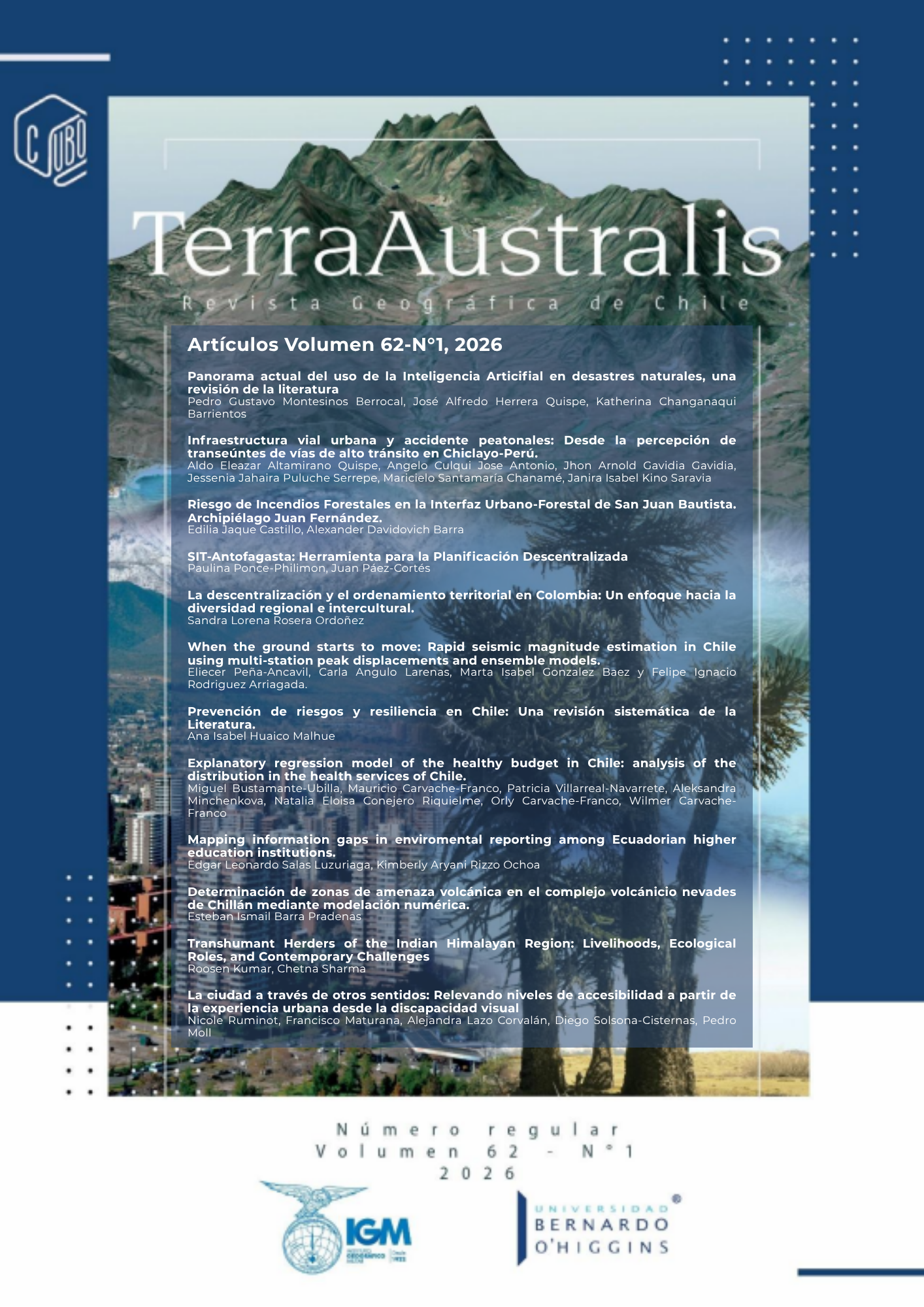
CURRENT OVERVIEW OF THE USE OF ARTIFICIAL INTELLIGENCE IN NATURAL DISASTERS: A LITERATURE REVIEW
DOI:
https://doi.org/10.23854/07199562.2026621.montesinoAbstract
Natural disasters have increased in recent years due to climate change, resulting in a significant number of victims and a growing need for efficient monitoring and classification systems. This study presents an overview of the main artificial intelligence (AI) technologies and automated monitoring applied to the risk assessment phase of disaster management. It describes the main types of natural disasters, such as floods, forest fires, earthquakes, landslides, tropical cyclones, drought, hurricanes, tsunamis, deforestation, and avalanches. It also examines the technological tools and AI algorithms used for their analysis, including Synthetic Aperture Radar (SAR), Geographic Information Systems (GIS), computer vision, decision support systems (DSS), and LiDAR. Furthermore, it identifies the most commonly used AI models in research, such as support vector machines (SVMs), random forests (RF), LSTM neural networks, and decision trees (DTs). Understanding the types of disasters and the technologies used to predict and detect them will allow for the identification of new research areas. Likewise, familiarity with the models and technologies described in the scientific literature guides the development of intelligent risk management systems and improves the effectiveness of emergency response teams.
Downloads
Downloads
Published
How to Cite
Issue
Section
License
Copyright (c) 2026 Revista Geográfica de Chile Terra Australis

This work is licensed under a Creative Commons Attribution 4.0 International License.
Copyright notice:
Revista Geográfica de Chile Terra Australis retains the economic rights (copyright) of the works published in the Revista Geográfica de Chile Terra Australis. The reuse of the content is allowed under a license:
CC BY
Recognition

This license allows others to distribute, remix, tweak and build upon your work, even for commercial purposes, as long as you are acknowledged as the author of the original creation. This is the most helpful license offered. It is recommended for maximum dissemination and use of the materials subject to the license.