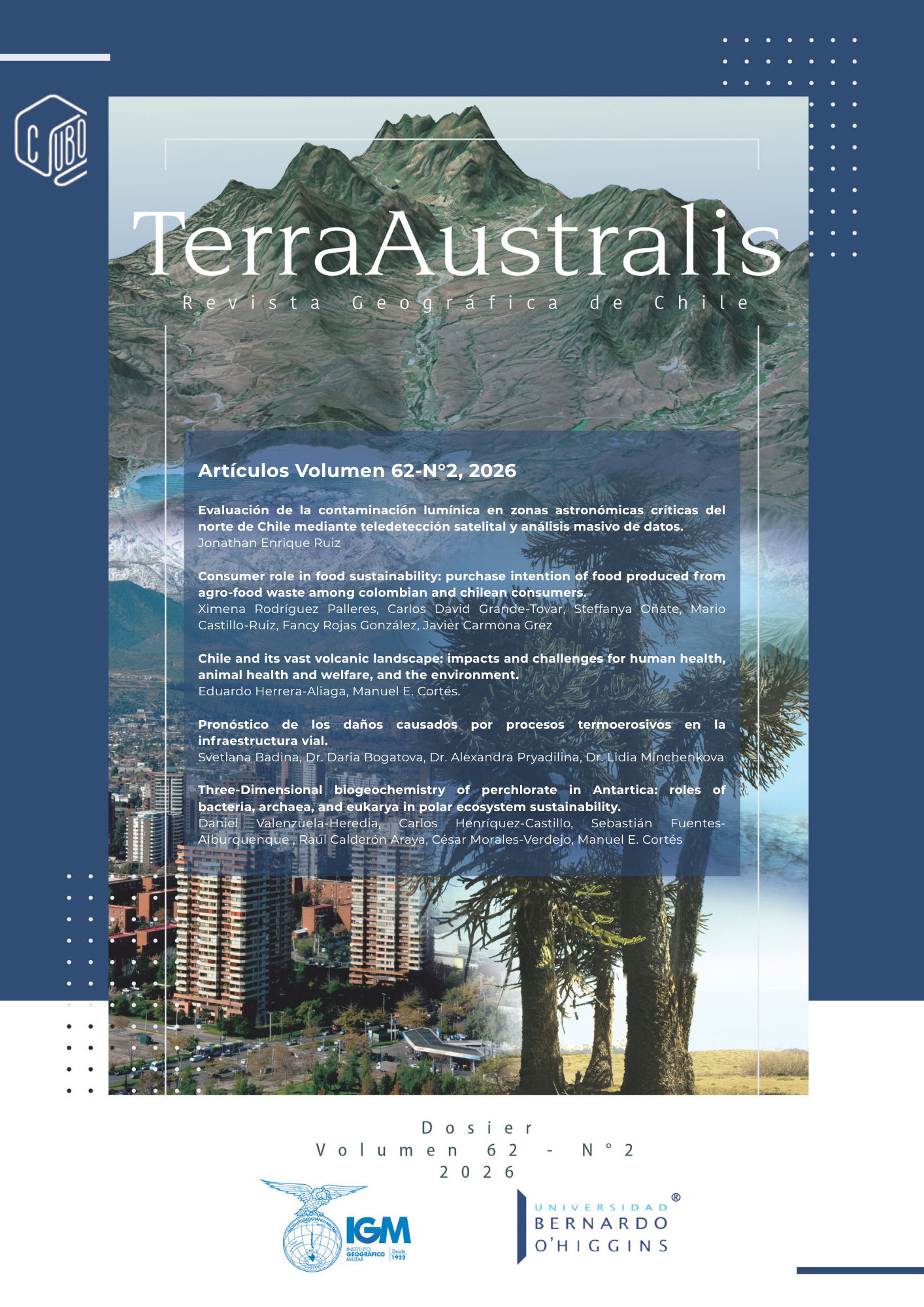
CHILE AND ITS VAST VOLCANIC LANDSCAPE: IMPACTS AND CHALLENGES FOR HUMAN HEALTH, ANIMAL HEALTH AND WELFARE, AND THE ENVIRONMENT
DOI:
https://doi.org/10.23854/07199562.2026622.cortesAbstract
Chile, with its extensive and active volcanic geography, faces significant challenges for human, animal, and environmental health. This article presents an interdisciplinary review of the health impacts of volcanic eruptions, with a focus on the effects of volcanic ash exposure. The review integrates evidence from geology, public health, veterinary medicine, and environmental sciences, highlighting both acute and chronic health outcomes, including respiratory, ocular, and dermal disorders, as well as mental health impacts and ecological disruption. Volcanic ash also poses threats to agriculture and water quality, while ash-derived soils can alter pollutant mobility, as demonstrated by differential herbicide sorption in volcanic soil types. Drawing on historical eruptions and current risk management strategies led by Chile’s geological agency (SERNAGEOMIN), the study critiques the fragmented response to volcanic crises and advocates for a One Health approach. This integrative framework promotes coordination across human, animal, and environmental health sectors. The authors argue that preparedness must include training of health professionals, real-time monitoring systems, and community education. The findings underscore the need for updated public health policies and curriculum innovation to address the unique and multifaceted challenges posed by volcanic activity in Chile and other geologically active regions.
Downloads
References
Bernstein, M., Pavez, A., Varley, N., Whelley, P., & Calder, E. S. (2013). Rhyolite lava dome growth styles at Chaitén Volcano, Chile (2008-2009): Interpretation of thermal imagery. Andean Geology, 40(2), 295-309. https://dx.doi.org/10.5027/andgeoV40n2-a07
Briceño Carrasquel, J. A., Ávalos Espinoza, D. P., Aguas Changoluisa, C. H., & Silva Ordóñez, M. del P. (2024). Evaluación de la toxicidad potencial de metales en un suelo cercano al volcán Tungurahua, Ecuador. Revista Científica y Tecnológica UPSE, 11(2), 46–56. https://doi.org/10.26423/rctu.v11i2.821
Cáceres-Jensen, L., Rodríguez-Becerra, J., Parra-Rivero, J., Escudey, M., Barrientos, L., & Castro-Castillo, V. (2013). Sorption kinetics of diuron on volcanic ash derived soils. Journal of Hazardous Materials, 261, 602–613. https://doi.org/10.1016/j.jhazmat.2013.07.073
Cáceres-Jensen, L., Rodríguez-Becerra, J., Garrido, C., Escudey, M., Barrientos, L., Parra-Rivero, J., Domínguez-Vera, V., & Loch-Arellano, B. (2021). Study of sorption kinetics and sorption–desorption models to assess the transport mechanisms of 2,4-dichlorophenoxyacetic acid on volcanic soils. International Journal of Environmental Research and Public Health, 18(11), 6264. https://doi.org/10.3390/ijerph18126264
Calder, E. S., Harris, A. J. L., Peña, P., Pilger, E., Flynn, L. P., Fuentealba, G. & Moreno, H. (2004). Combined thermal and seismic analysis of the Villarrica volcano lava lake, Chile. Revista Geológica de Chile, 31(2), 259-272. https://dx.doi.org/10.4067/S0716-02082004000200005
Carn, S. (2024). Michigan Tech Research Award Winner Tracks Impacts of Volcano Behavior Around the World. Michigan Technological University. Recuperado de: https://www.mtu.edu/news/2024/08/michigan-tech-research-award-winner-tracks-impacts-of-volcano-behavior-around-the-world.html
Cook, A.G., Weinstein, P. & Centeno, J.A. (2005). Health effects of natural dust. Biological Trace Element Research, 103, 1–15. https://doi.org/10.1385/BTER:103:1:001
Cortés, M.E. (2025). A cinco años de la catástrofe: aprendizajes y desafíos a partir de la pandemia por COVID-19. Acta Bioquímica Clínica Latinoamericana, 59(2), 155-156.
Cortés, M. E., Alfaro Silva, A. A., & Herrera Aliaga, E. A. (2025). Salud humana, olas de calor e incendios forestales en Sudamérica en el contexto del cambio climático. Revista Cubana de Medicina Militar, 54(1), e025060029. Recuperado a partir de: https://revmedmilitar.sld.cu/index.php/mil/article/view/60029
Cuevas, A. & Arellano, A. (2022). Redes semánticas naturales en el estudio de la percepción de riesgo por caída de ceniza volcánica en Tonila, México. Revista Geográfica de Chile Terra Australis, 58, 11-21.
Darwin C. (1921). Diario del viaje de un naturalista alrededor del mundo. Calpe. Madrid.
FAO, UNEP, WHO, and WOAH. 2022. One Health Joint Plan of Action (2022-2026). Working together for the health of humans, animals, plants and the environment. Rome. https://doi.org/10.4060/cc2289en
González-Mena, M., Guerra-Zúñiga, M., Jofré-González, J.T., & Collao-Ferrada, X. (2025). Efectos sociosanitarios de la sequía en Chile, una revisión de la literatura. ARS Medica (Santiago), 50(1), 34-42. https://dx.doi.org/10.11565/arsmed.v50i1.2076
Grob, E., Oyarzún, M., Cavieres, I., Zarges P., Bustamante, G. (2012). ¿Son las cenizas volcánicas un riesgo para la salud respiratoria? Revista Chilena de Enfermedades Respiratorias, 28(4), 294-302. http://dx.doi.org/10.4067/S0717-73482012000400005
Hall, M., Ramón, P., Mothes, P., LePennec, J. L., García, A., Samaniego, P., & Yepes, H. (2004). Volcanic eruptions with little warning: the case of Volcán Reventador's Surprise November 3, 2002 Eruption, Ecuador. Revista Geológica de Chile, 31(2), 349-358. https://dx.doi.org/10.4067/S0716-02082004000200010
Hawa, N. N., Zakaria, S. Z. S., Razman, M. R., Majid, N. A., Taib, A. M., & Emrizal. (2023). Element of disaster risk reduction in geography education in Malaysia. Sustainability, 15(2), 1326. https://doi.org/10.3390/su15021326
Horwell, C.J. & Baxter, P.J. (2006). The respiratory health hazards of volcanic ash: a review for volcanic risk mitigation. Bulletin of Volcanology, 69, 1-24. https://doi.org/10.1007/s00445-006-0052-y
Jorquera González, H. (2015). Introducción a la contaminación atmosférica. Santiago de Chile: Ediciones UC.
Lara, L. E. (2009). The 2008 eruption of the Chaitén Volcano, Chile: a preliminary report. Andean Geology, 36(1), 125-129. https://dx.doi.org/10.4067/S0718-71062009000100009
Lara, L. & Calderón, R. (2015). Peligro y riesgo específico asociado al volcán Chaitén. Magallania, 43(3), 19-30. http://dx.doi.org/10.4067/S0718-22442015000300003
Linhares, D., Pimentel, A., Borges, C., Cruz, J. V., Garcia, P., & Dos Santos Rodrigues, A. (2019). Cobalt distribution in the soils of São Miguel Island (Azores): From volcanoes to health effects. The Science of the total environment, 684, 715–721. https://doi.org/10.1016/j.scitotenv.2019.05.359
Lohmar, S., Robin, C., Gourgaud, A., Clavero, J., Parada, M. A., Moreno, H., Ersoy, O., López-Escobar, L., & Naranjo, J. A. (2007). Evidence of magma-water interaction during the 13,800 years BP explosive cycle of the Licán Ignimbrite, Villarrica volcano (southern Chile). Revista geológica de Chile, 34(2), 233-247. https://dx.doi.org/10.4067/S0716-02082007000200004
Major, J. J., & Lara, L. E. (2013). Overview of Chaitén Volcano, Chile, and its 2008-2009 eruption. Andean Geology, 40(2), 196-215. https://dx.doi.org/10.5027/andgeoV40n2-a01
Major, J. J., Pierson, T. C., Hoblitt, R. P., & Moreno, H. (2013). Pyroclastic density currents associated with the 2008-2009 eruption of Chaitén Volcano (Chile): Forest disturbances, deposits, and dynamics. Andean Geology, 40(2), 324-358. https://dx.doi.org/10.5027/andgeoV40n2-a09
Manterola, C., Rivadeneira, J., Leal, P., Rojas-Pincheira, C., & Altamirano, A. (2024). Una Sola Salud. Un Enfoque Multisectorial y Transdisciplinario. International Journal of Morphology, 42(3), 779-786. https://dx.doi.org/10.4067/s0717-95022024000300779
Motoki, A., Orihashi, Y., Naranjo, J. A., Hirata, D., Skvarca, P., & Anma, R. (2006). Geologic reconnaissance of Lautaro Volcano, Chilean Patagonia. Revista Geológica de Chile, 33(1), 177-187. https://dx.doi.org/10.4067/S0716-02082006000100008
Naranjo, J. A., & Haller, M. J. (2002). Erupciones holocenas principalmente explosivas del volcán Planchón, Andes del sur (35°15'S). Revista geológica de Chile, 29(1), 93-113. https://dx.doi.org/10.4067/S0716-02082002000100006
Naranjo, J.A., & Polanco, E. (2004). The 2000 AD eruption of Copahue Volcano, Southern Andes. Revista geológica de Chile, 31(2), 279-292. https://dx.doi.org/10.4067/S0716-02082004000200007
Navarro-Sempere, A., Martínez-Peinado, P., Rodrigues, A. S., García, P. V., Camarinho, R., García, M., & Segovia, Y. (2021). The Health Hazards of Volcanoes: First Evidence of Neuroinflammation in the Hippocampus of Mice Exposed to Active Volcanic Surroundings. Mediators of inflammation, 5891095. https://doi.org/10.1155/2021/5891095
Ortiz Apuy, E., Mora Barrantes, J. C., & Sibaja Brenes, J. P. (2022). Estudio preliminar con respecto a los efectos en la salud de trabajadores y su relación con la exposición a emisiones gaseosas volcánicas. Un caso de estudio en dos volcanes activos de Costa Rica. Uniciencia, 36(1), 761-780. https://dx.doi.org/10.15359/ru.36-1.49
Padrón-Armas, A. G., Trujillo González, J. V. (2025). Salud mental juvenil tras la erupción del volcán Tajogaite en La Palma. Análisis multivariante de los efectos de la exposición directa e indirecta. Aposta. Revista de Ciencias Sociales, 105, 143-155, http://apostadigital.com/revistav3/hemeroteca/agoretty.pdf
Piña-Gauthier, M., Lara, L. E., Bataille, K., Tassara, A., & Báez, J.C. (2013). Co-eruptive deformation and dome growth during the 2008-2009 Chaitén eruption, Southern Andes. Andean Geology, 40(2), 310-323. https://dx.doi.org/10.5027/andgeoV40n2-a08
Plaza, P.I. et al. (2019). Natural hazards and wildlife health: The effects of a volcanic eruption on the Andean Condor. The Condor, 121(3), duz031.
Sellés, D., Rodríguez, A. Carolina, Dungan, Michael A., Naranjo, José A., & Gardeweg, Moyra. (2004). Geochemistry of Nevado de Longaví Volcano (36.2°S): a compositionally atypical arc volcano in the Southern Volcanic Zone of the Andes. Revista Geológica de Chile, 31(2), 293-315. https://dx.doi.org/10.4067/S0716-02082004000200008
Servicio Nacional de Geología y Minería – SERNAGEOMIN. (2018). Chile: territorio volcánico. Santiago, Chile: Servicio Nacional de Geología y Minería.
Servicio Nacional de Geología y Minería – SERNAGEOMIN – Red Nacional de Vigilancia Volcánica. (2025). Alertas volcánicas. https://rnvv.sernageomin.cl/alertas-volcanicas/
Servicio Nacional de Geología y Minería – SERNAGEOMIN (2025). Peligros volcánicos. https://www.sernageomin.cl/visor-volcanes/
Sinclair J. R. (2019). Importance of a One Health approach in advancing global health security and the Sustainable Development Goals. Revue scientifique et technique (International Office of Epizootics), 38(1), 145–154. https://doi.org/10.20506/rst.38.1.2949
Tilling, R. I. (2009). Volcanism and associated hazards: the Andean perspective, Advances in Geosciences, 22, 125–137. https://doi.org/10.5194/adgeo-22-125-2009
United Nations Office for Disaster Risk Reduction. (2015). Sendai framework for disaster risk reduction 2015–2030. UNDRR. https://www.undrr.org/publication/sendai-framework-disaster-risk-reduction-2015-2030
University of Canterbury. (2026). Disaster risk and resilience. University of Canterbury. https://www.canterbury.ac.nz/study/academic-study/subjects/disaster-risk-and-resilience-pg
USGS Volcano Hazards Program (2015). Impacts of Volcanic Ash: Animals (Livestock). https://volcanoes.usgs.gov/volcanic_ash/animals_livestock.html
Vargas-Alfaro, Maite, Douglas-Gordon, Sharline, & Chamizo-García, Horacio Alejandro. (2023). Exposición a ceniza volcánica producida por el volcán Turrialba y enfermedades respiratorias, Costa Rica, 2016. Horizonte sanitario, 22(3), 517-526.https://doi.org/10.19136/hs.a22n3.5628
Wilson, T. M., Stewart, C., Sword-Daniels, V., Leonard, G. S., Johnston, D. M., & Cronin, S. J. (2012). Volcanic ash impacts on critical infrastructure. Physics and Chemistry of the Earth, Parts A/B/C, 45–46, 5–23. https://doi.org/10.1016/j.pce.2011.06.006
World Health Organization. (2019). Health emergency and disaster risk management framework. WHO. https://apps.who.int/iris/handle/10665/326106
World Health Organization. (2020). Fact sheets: Health emergency and disaster risk management (Health EDRM). WHO. https://www.who.int/publications/m/item/health-emergency-and-disaster-risk-management-%28edrm%29-fact-sheets
Witter, J. B., & Delmelle, P. (2004). Acid gas hazards in the crater of Villarrica volcano (Chile). Revista Geológica de Chile, 31(2), 273-277. https://dx.doi.org/10.4067/S0716-02082004000200006
Zinsstag, J., Crump, L., Schelling, E., Hattendorf, J., Maidane, Y. O., Ali, K. O., et al. (2018). Climate change and One Health. FEMS Microbiology Letters, 365(11), fny085. https://doi.org/10.1093/femsle/fny085
Downloads
Published
How to Cite
Issue
Section
License
Copyright (c) 2026 Revista Geográfica de Chile Terra Australis

This work is licensed under a Creative Commons Attribution 4.0 International License.
Copyright notice:
Revista Geográfica de Chile Terra Australis retains the economic rights (copyright) of the works published in the Revista Geográfica de Chile Terra Australis. The reuse of the content is allowed under a license:
CC BY
Recognition

This license allows others to distribute, remix, tweak and build upon your work, even for commercial purposes, as long as you are acknowledged as the author of the original creation. This is the most helpful license offered. It is recommended for maximum dissemination and use of the materials subject to the license.